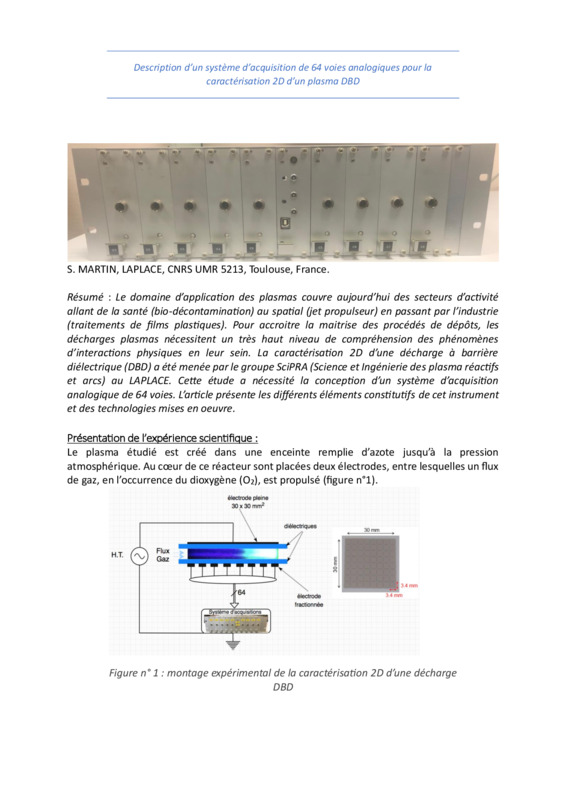
Le domaine d’application des plasmas couvre aujourd’hui des secteurs d’activité allant de la santé (bio-décontamination) au spatial (jet propulseur) en passant par l’industrie (traitements de films plastiques). Pour accroitre la maitrise des procédés de dépôts, les décharges plasmas nécessitent un très haut niveau de compréhension des phénomènes d’interactions physiques en leur sein. La caractérisation 2D d’une décharge à barrière diélectrique (DBD) a été menée par le groupe SciPRA (Science et Ingénierie des plasma réactifs et arcs) au LAPLACE. Cette étude a nécessité la conception d’un système d’acquisition analogique de 64 voies. L’article présente les différents éléments constitutifs de cet instrument et des technologies mises en oeuvre.
The STAR experiment at RHIC is planning to upgrade the Time Projection Chamber which lies at the heart of the detector. We have designed an instrument to measure the tension of the wires in the multi-wire proportional chambers (MWPCs) which will be used in the TPC upgrade. The wire tension measurement system causes the wires to vibrate and then it measures the fundamental frequency of the oscillation via a laser based optical platform. The platform can scan the entire wire plane, automatically, in a single run and obtain the wire tension on each wire with high precision. In this paper, the details about the measurement method and the system setup will be described. In addition, the test results for a prototype MWPC to be used in the STAR-iTPC upgrade will be presented.
We present a novel electrical technique to measure the tension of wires in multi-wire drift chambers. We create alternating electric fields by biasing adjacent wires on both sides of a test wire with a superposition of positive and negative DC voltages on an AC signal (V-AC +/- V-Dc). The resulting oscillations of the wire will display a resonance at its natural frequency, and the corresponding change of the capacitance will lead to a measurable current. This scheme is scalable to multiple wires and therefore enables us to precisely measure the tension of a large number of wires in a short time. This technique can also be applied at cryogenic temperatures making it an attractive solution for future large time-projection chambers such as the DUNE detector. We present the concept, an example implementation and its performance in a real-world scenario and discuss the limitations of the sensitivity of the system in terms of voltage and wire length.
A wire tension meter has been developed for the multi-wire proportional chambers of the LHCb muon detector. The wire tension is deduced from its mechanical resonance frequency. In the LHCb muon chambers. the wires are 2 mm apart and electrically connected in groups of 3-32, so that the wire excitation system must he precisely positioned with respect to the wire to be tested. This wire is forced to oscillate by it periodic high voltage applied between that wire and it non-oscillating "sense wire" placed parallel and close to it. This oscillation produces it variation of the capacitance between these two wires which is measured by a high precision digital electronic circuit. At the resonance frequency this capacitance variation is maximum. The system has been systematically investigated and its parameters were optimized. In the range 0.4-1 N a good agreement is found between the mechanical tension measured by this system and by a dynamometer. (c) 2005 Elsevier B.V. All rights reserved.